It seems like a short time between winter and spring this year. Not much more than a week ago we were still having frigid temperatures. The last of the snow finally melted in our yard this week, with most of it gone a week ago.
Now this week, we have tulip bulbs coming up, and crocuses too! Won't be long before I am at it, cutting everything down and getting the yard ready for another showcase summer. Hopefully we will be on more of a normal moisture cycle this year. The past seven years we have been in this house have certainly been eratic from a weather and moisture standpoint. Not much to build or landscape in the garden this year, which is good, cuase this spring we are painting the exterior of the house. That will be a project.
I am also looking for large 20 inch or so hanging baskets for our porch. If anyone knows were to get some, please let me know!
Friday, March 09, 2007


Friday, February 02, 2007
My Current Thoughts and Musings
It has been awhile since I blogged. I apologize to everyone, but to be honest I havn't really been inspired for awhile, or perhaps I just had a serious case of writers block.
This has been a strange winter around here. The last postings I did were of our pre-Christmas blizzard. Oddly enough, a week after that storm, we had another pretty big one, and it seems a weekly storm of some sort. And it has been VERY COLD this winter! Usually we get an arctic blast for a week or so in the winter, then it is over. And we always have some very warm days during the winter when we can get out and enjoy life, go for a walk, play a round of golf, ride bikes, or even clean up the yard a little bit.
Not this year...we are in week 7 of cold snowy weather. The snow from the blizzard is STILL on the ground! and we have hardly had any days above 40, with most of them in the 20's and 30's, or colder. I am getting cabin fever big time. I have a burning desire to build something, but it is way too cold in the garage to fire up the woodshop. Even though the garage is fully insulated, it would cost a fortune to crank up the space heaters to get the temperature into the mid 40's so I could work without gloves. Fortunately, I did figure out how to completely drain the trailer this year, so hopefully no broken pipes this time! I need a break from this weather...Calgon take me away!
On the bright side, business has picked up dramatically in the last couple of weeks! If this keeps up, it looks like this will be a good year, and my inspiration is starting to make a comeback!
Jan. Fugglies

OK, so I am a couple of days late posting, but I found this one in January! This wonderful project is a perfect example of what not to do for project planning and streetscape design! This particular apartment project is in Castle Rock, Colorado, next door to one of my projects. They both were designed and approved roughly at the same time, but what a difference in concepts and execution!
The apartment home site was originally a beautifully sloping site vegetated with scrub oak and other native plants. The developers of the apartment homes probably had a standard building plan they wanted to use (usually on flat sites), so in order to get that product to work on this site, they had to construct some incredible retaining walls to pull this off. The picture shows the result of what happened along the public street adjacent to the site. Not only are the walls incredibly tall (around 40 feet at one point), they were designed without any anesthetics in mind. There is no variation in color, no pattern, nothing. Just a huge homogeneous wall. Then, they didn't even bother to screen it plant material, trees, or shrubs. Just a few trees scattered here and there. Ugly.
Watch for my other post of our project coming up shortly.
Saturday, December 23, 2006
Christmas Blizzard 2006


Ok, so it isn't quite Christmas, but close enough. Once again, we find ourselves under a blizzard, with about 2 feet of snow dumped on us. This doesn't quite get up to the March 2003 blizzard when we had over 3 feet of snow, but with this storm, the snow will be with us for quite a while, as the cooler temperatures won't melt it very fast.
It started snowing on us early Wednesday, and by noon at work, we called it a day. I went to fetch my daughter at school, and went home. by then we had about 4-6 inches. I drive a true 4 wheel drive SUV (and right now I am glad I do!), so I didn't have any problems getting around, except for the other drivers on the road. The next morning, the snow had stopped, but the wind hadn't! There were areas that were bone dry, and other places with 3-4 foot drifts! We had to keep our cars outside in the driveway, so we wound up with some major drifts around the cars. Thank goodness for my neighbor, who has a bobcat tractor. He used it to dig out the driveways of his neighbors! Course, I had to shovel out the drifts around the cars. I am also thankful now that we live on a collector that is a designated snow route...we get plowed! The first plow came through at 10 am following the end of the storm. While it was nice to get the street plowed, it did add an additional 2 feet of snow to the end of the driveway! Once again, thank goodness for my neighbor! He did make some major piles of snow in the street, that the kids have had a good time playing on!
Other than having closed the office for a couple of days, this storm has been nice in that it has rather put me in the Christmas spirit with a few days off, shoveling snow, and the like. It is very pretty out, and we are sure to have a white Christmas this year!
Merry Christmas everyone, and have a Happy New Year!
Wednesday, December 06, 2006
December Fuglies


The other day I was driving down C-470 in south Denver, when my eye was caught by this housing development. I simply had to get off the interstate and explore this one...and I could not believe my eyes! This has to be one of the worst developments I have seen, particularly for townhomes! The first picture is what you see when you first drive into the development...nothing but a solid row of garage doors! There is no focal point, there is no sense of community, no sense of arrival. Nothing but a series of garage doors. The other side of the buildings isn't much better. This is what visitors see when they come to your home...nothing but lined up porches, with little to break it up, or identify one unit from the next. In the front there isn't even any differentiation in the architecture...talk about boring!
I am blown away by three things...that a developer would build something like this, that a jurisdiction would approve it...and even more surprised that buyers would buy this! Granted, this parcel of land was landlocked between two apartment complexes, and was long and narrow, but I would think that something else could have been done. Something to give this development some sense of arrival, some focal point. Sacrifice a few units to create something special. How about being proud of something that you build?
Tuesday, November 28, 2006
November Fugly Award!


The November fugly award goes to a particular streetscape in the Greeley area. In this streetscape, somebody decided to plop down some large boulders as landscape elements. Now we use boulders all the time, but to be properly done, they need to be partially buried to look more or less natural. Not these, they were just plopped on top of the ground! And not just in turf areas, but in the concrete areas of the splitter islands for the round-a-bout. These look hideous. Not only are they out of scale, they aren't buried properly, nor are they grouped to look some kind of setting. Nope...plop one here, one there, totally random.
Too bad, this was a nice project overall.
Saturday, November 25, 2006
Consumer Sustainability
While helping to prepare some of the meal for Thanksgiving, I got out an electric hand mixer that I use a lot for small jobs. Using this hand mixer got me to thinking about a different aspect of sustainability, and that is how we have become a throw away society. These days, most of the everyday products we use are made of plastics or other similar materials, particularly the gears in the motors. These arn't good plastics either, but cheap plastic designed to keep the end product costs low. But what usually happens? These products, particularly household kitchen appliances work well for a few months, maybe even a few years, then they break. Because they are so cheap, it is easier to buy a new one and throw the old one away...contributing to our landfill waste.
What is it that got me thinking about this? The hand mixer I mentioned above, is an old mixer. I got it from my mother when I settled in my own place 20 years ago. Now having a kitchen appliance for 20 years these days is really something, but this hand mixer is older than that. I remember using it as a kid, in fact I remember this particular mixer being around as long as I can remember....so that is pushing 40 years! And it is still going strong. Now it might not be the prettiest thing, it isn't stainless steel, it isn't shiny white, but a faded yellow...and it is made of metal. But in this case, it isn't a beauty contest. It stays in the drawer and only comes out when needed, usually once a week or so.
Imagine what it would be like if common everyday items, be it kitchen appliances, toys, or whatever, where built to last. We wouldn't have to throw everything away. Sure it might be more expensive initially, but it would sure be cheaper in the long run. Imagine having to shell out $100 or so for a good hand mixer that lasted 40+ years, instead of shelling out $30 every few years? Imagine how much less stuff would be trash, how much less resources we have consumed in making and transporting those products...now that is sustainability.
Sunday, November 19, 2006
Award Winner!

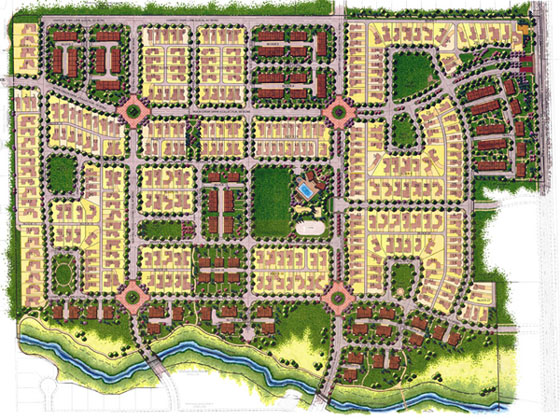
On November 15th, I was the proud recepient of the first every Urban Design award given out by the City of Fort Collins. We recieved the award for the Harvest Project that we designed a few years back, and which recently completed construction. The city gave out a total of 12 awards in 6 categories. The Harvest project was the only award given to a single family detached community, that was a greenfield development. It was an honor to recieve such an award.
 Harvest was designed based on new urbanism principles. There are over 500 homes in the 105 acre community, with a mix of single family and townhomes. Within that is a broad mix of product types that where interwoven together. There were 4 single family product lines, with a variety of lot size needs. All these lot sizes where woven together within blocks to create a dynamic mix of homes and home prices. Also mixed in, where two townhome products. Again, these where interspersed throughout the community. Also included where
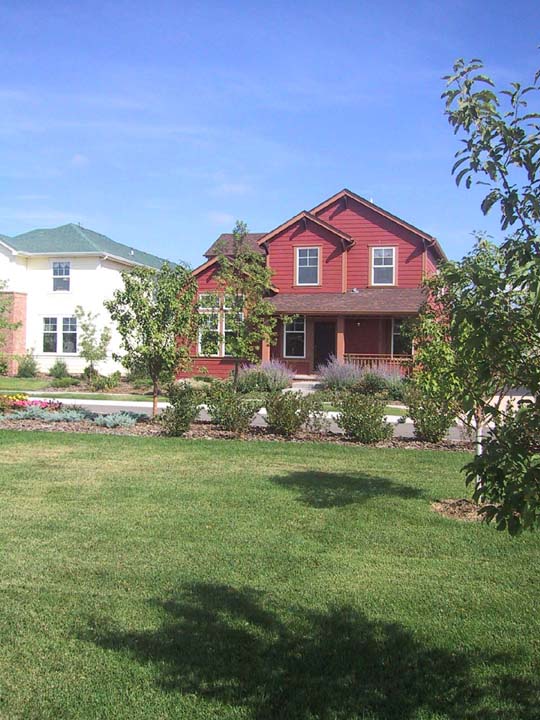 4 small pocket parks, a community recreation center that occupies an entire city block. This site is also surrounded by a public park, and a city natural area. The community was designed to be walkable with detached walks, street trees, and 95% of the garages are accessed by alleys. My client, Writer Homes (subsequently purchased by Standard Pacific Homes) designed an entirely new product line for this community. In addition, they used a variety of color schemes, to really create a vibrant streetscape. This is indeed a neighborhood and community to be proud of.
Back Alley Walkability - Fort Collins Style

Last month, ASLA's blog, The Dirt, posted a ditty on Back Alley Walkability. I posted a comment that I would write about what Fort Collins has done recently to create walkable alleys, so here it is!
Like Architect David Winslow, Fort Collins downtown alleys are also widely used by pedestrians. In 2004 The City of Fort Collins, in conjunction with the Downtown Development Authority (DDA) embarked on a plan to improve two of the alleys that had been widely used by pedestrians for years as mid-block shortcuts. One of the alleys, Trimble Court, (pictured to the left) was a mid-block shortcut between the main drag of College Avenue and Old Town Square, a pedestrian mall. This alley already had a well established artists studio on it. The other alley, Tenney Court, became a widely used pedestrian shortcut after the construction of the Civic Center Parking Structure.
Both alleys had numerous trash dumpsters, utility boxes, poor lighting, and were generally unattractive. The goals of the city and the DDA was to consolidate trash dumpsters, screen and/or relocate utility boxes, vastly improve lighting and other pedestrian amenities such as providing benches, planters, new paving, and the improve the drainage and more.

As can be seen in the photos, all this has been achieved and more. The picture shown to the left, Tenney Alley, was in terrible shape prior to redevelopment. There were numerous trash dumpsters, graffitti, and a severely sloping pavement to accomodate the drainage. This carried through all the way to the public street. Prior to the year 2000, this alley was mostly a service alley. However, in 2000, the civic center parking structure was completed within this block, and therefor this alley became a pedestrian shortcut between the parking garage and the downtown shopping district. This parking garage also has liner stores and offices (of which our office is located), so a lot of employees also used this alley.

The major issue that was solved with this alley reconstruction, was the drainage. They installed a new drain line, leveled off the alley, and installed new modular pavers that really give the alley life. In addition, new light fixtures and planters were added. The light fixtures dramatically improved the nighttime safety of the alley, while the planters
 add a lot of summer color.However something else happened after this alley was completed that the DDA hoped would happen...a local businees owner reconstructed the alley facade of there building to create an inviting entrance off Tenney Court. Hopefully this will be the first of many revitalizations of Fort Collins Alleys. Another fun aspect of this particular alley, through the art in public places program, the utility boxes were turned into public art! A local artist has been painstakintly painting these boxes with a bubble motif...Note, that she is doing this by hand!
Both of these alleys recently won an urban design award from the City of Fort Collins, issued to the designers, EDAW and BHA designs.
Monday, November 13, 2006
Straw Bale Home - an update
Good News, the straw bale home that I blogged about last month has now broken ground! Course at the moment, it is literally a hole in the ground, I am anxious to see how they will build this home, the structural considerations, etc. Especially since this will be a 3 story home.
More to come!!!
More to come!!!
Habitat Update
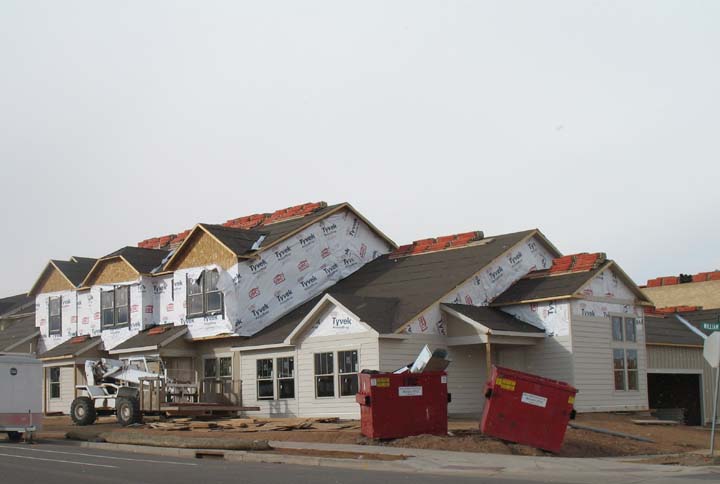

I know it has been awhile since I blogged about the Habitat project, but they are moving along. Framing is complete, mechanicals are being installed inside, and the siding, doors, and windows are being installed. Now you can really start to see how the units are going to look, and how they fit into the overall community.
Meanwhile, we are busy designing the next eight units to be built across the street.
Tuesday, October 17, 2006
The 300 Millionth Citizen
The other day, in my wanderings around the mountains, I was listening to the Jay Marvin radio show, and they were talking about how on that day, the 300 millionth citizen of this country was supposedly born. Of course, this feat has both sides talking. One side has the economic pundits talking about how this will help the economy to grow and thrive, as growth is good for the overall economy. Of course, the other side, largely environmental, was saying that growth isn't necessarily good, as how are we going to have the resources to care for these people? Not only in physical infrastructure, such as roads, schools, etc., but also with water, electricity, heat, and so on.
I think both sides are right. I do believe that growth is good for the overall economy, as non-growth brings about stagnation. At least in our current economic model, and the only one that I am familiar with. I am also talking about slower sustainable growth, not booming economies. Booms always bust, every time.
However, I also understand where the environmentalist and other no or slow growthers are coming from. Our resources are not finite, we do need to be careful in what we use. I do believe that we can accommodate future growth in our population with sound choices that are made now, that look at the future.
For the most part, our current way of life, and our economy is built on instant satisfaction, on how we get the biggest bang for our buck today. This isn't always bad, as we all enjoy getting the lowest price we can on goods and services. However, we need to look at the life cycle costs of what we do. Is paying an extra $1,000 for a super efficient furnace good for the long haul?
We need to look at our development patterns. We need to build mixed use and mixed income communities. We need to build at higher densities. We need to get away from being dependent on the automobile. We also need to build our homes and commercial buildings for the long haul. If we truly look at what it costs to do it right, and amortize it over the life of the structure, the extra cost is minuscule. We need to build homes that don't fall apart in a few years. We need to build homes far more energy efficiently. The technology is there, it can be done, and it doesn't cost a great deal more.
Take for example, my biggest pet peeve, all the turf grass we plant. Do we really need it all? How much of that turf really get used? How much of it is played on, versus how much it gets looked at, whizzing by at 40 mph? This is where developers and the design community need to honestly think about weighing the cheap costs of installing all that turf now, versus the long term maintenance issues of all that turf. Is it really cheaper? I don't think so. Planting shrubs, perennials, or native grasses might cost more now, but it is also more aesthetically pleasing, and costs less to maintain!
These are just a few of the issues. We all make choices everyday that impact the future. We all need to weigh those choices, and think about the long term impacts.
Think about it.
Stapleton
I have visited this wonderful community several times this summer, with many different friends. For those of you who have not heard of Stapleton, this is one of the largest infill redevelopment projects in the country, right here in Denver. It is on the site of the former Stapleton International Airport, and is based on New Urbanism planning concepts using the Built Green program as a standard for all the homes, and other sustainable measures as well.
 This community has several wonderful things about it, but the one I want to focus on today is water conservation, and the effect that has on sustainability. One of the things they have done, is require build to lines for most of the homes within Stapleton. What this does, is require homes to be built close to the street, rather than set way back from the street. Being close to the street has many advantages, among them social interaction, but the best part of it, is that this discourages people from planting front lawns. Most of the homes are set back 8, 10 up to 15 feet from the sidewalk. This dimension is not sufficient to efficiently irrigate turf, so what most people have done is plant it up! The street scape is vibrant with the colorful array of perennials, ornamental grasses, flower pots, and shrubs! It is absolutely gorgeous! The only grass you find here, is in the parkway strips between the street and the sidewalk.
Of course, there are other wonderful water conservation landscape techniques that Stapleton employs, and I will talk about these in future episodes.
Northern Exposure ala "Estes Park"!

Today I had to visit Estes Park for a business meeting. Today also was the first major snowstorm to hit the front range, but that is beside the point. While in Estes Park this morning, I was just amazed to see Elk wandering down the street! This big one was just staring at me, daring me to move my Durango! After he finally got off the street, I parked my car, and this big guy just looked at me, no more than 10 feet away! Obviously they felt very safe and right at home...reminded me of Northern Exposure.
Tuesday, October 10, 2006
Built Green Homes - Straw Bale Style!

Here is a new twist in the green building movement, at least as far as I know. A Boulder based builder is planning to build 12 straw bale homes in a new urbanist project in Fort Collins, called Old Town North.
The first home that Merten Homes is planning on building is a 3,035 square foot 3-story home that is pictured to the left. This will be followed by a 2 story home next door. As of this point in time, I don't know what the asking price is, but I am highly curious to see these homes constructed. As far as I know, this will be the first attempt by a builder in this area to build straw-bale homes in a multi-home setting, and particularly in an urban environment. Talk about the ultimate in sustainability!
As with the habitat homes, I will follow the construction of these homes, and post updates and pictures, and most curiously, about the structure of these units! And of course, I will be very interested in how the market will react to these units! Stayed Tuned!
Thursday, October 05, 2006
The plague of planners...my response
I recently read a Toronto Globe and Mail article that blasted planners, both private and public. Even though, this article was originally posted back in June, I simply have to respond to it. Among many points made in the article, the ones that really rile me is the blame the author places on comprehensive planning for the resulting high density, gridlock, and high housing prices. The author goes on to point out that planning cannot predict and plan for the complexities of the city.
I quote "Urban planning advocates have failed to learn the chief lesson of the 20th century: that comprehensive, centralized government planning does not work. Planning a city or urban area presumes that planners can gather all the data they need, predict the future, and be immune to political pressures...The truth is, no one can ever collect or understand enough data to understand a complex urban area, much less predict the future."
Now I agree with the author that cities are extremely complex places, and changing one thing has a ripple effect through many other things and systems. I also agree that predicting the future is extremely difficult. All we can do is make an educated guess.
But if we don't do comprehensive planning, then what is the alternative? Should we just have a free for all? Should we let anything be built anywhere? Should we ignore the environment? Should we ignore the strain on the infrastructure? Should we just develop in extremely low densities, and gobble up all the farmland? This was basically allowed to happen in Houston until the late 80's. And guess what? They have extreme traffic congestion too! The author doesn't like comprehensive planning, but doesn't offer up any alternatives.
Is comprehensive planning perfect? Heck no, mistakes have been made through history. The author points out the failures of the super blocks of affordable housing. Many of those projects were poorly conceived and planned, but we have learned from them. We have learned that massive blocks of single use planning isn't good for any socio-economic segment, or use. In my mind, the biggest mistake of the last 50 years of development was the invention of single use zoning laws. These are still prevalent in most communities and preclude a mix of incomes and housing types, much less mixing it with commercial and retail.
This is what has caused the gridlock. Single use planning. This forces people to live far from where they shop, far from where they work, far from where they recreate. This has forced people to drive there cars to go shopping, go to work, they even have to drive to the health club to get exercise! This is what makes mixed use zoning so enticing! It allows people to live, work and shop in one area! Heck, you could even have your office downstairs, and live upstairs! This is called New Urbanism, and is something I am a big proponent of.
What would our cities look like today if we hadn't had 50 years of single use zoning? what would have happened if the development patterns of that time prior to the 50's been continued? Would we have had a need for massive superhighways? Would we have a need for supercenters? Would the corner grocery store have survived? Would we have become socially isolated from each other?
People today are looking for that in new communities. A real sense of place and community is almost more important than the home anymore. A connection to your neighbors, feeling safe. I live in megalopolis of Northern Colorado, and the best selling communities by far are new urbanism communities. Communities such as Stapleton and Lowry in Denver are runaway successes. These two communities have managed to create a wide variety of housing with many price points all the way from affordable to multi-million dollar. They have combined merchant housing with custom homes, traditional with modern. They have included the commercial areas, artist studios, work and office space.
I like them because I could live there, have my office, walk to work, and have my bank and grocery store right there! We could get rid of a car!
Imagine that, what if it were possible for every family to reduce itself down to one car....what would happen to gridlock then?
A little more history

Recently my wife and I passed through Georgetown, Colorado, on our way home from a weekend getaway. Well, I decide to find the house that my mom spent her early years in. This was in the mid-40's to the early-50's. They lived on the edge of the mountain, right next to what was then, the city jail. Next to here, is a picture of the house, and believe it or not, it looks almost identicle to when my mom lived there (or so she says). She also says that she remembers it being much bigger when she lived there! My great grandma also lived in Georgetown, in a smaller house down the street, though I don't remember exactly where is was.
My grandpa owned and operated the local newspaper during his tenure there. I don't know the exact dates, but after a bit, he sold that, and started a printing company in Denver, where he made his fortune. My mom remembers traveling to the big city of Idaho Springs to go to the movies, or a night out on the town. Of course, this was all long before the interestate system, much less a good highway system in the mountains, so a trip to Denver was an all day adventure at best, and wasn't done often. After a few years of my grandpa commuting to Denver, they finally sold both Georgetown houses, and all moved to Denver.
Habitat Update 10-05-06


Well, I have been a bad boy, as I am a little tardy in my updates of the Habitat project. I was out there a couple of times, and had forgot my camera! Anyway, there has been a lot of progress made since the last update. The second floor and walls are now up on all of the units, the carraige units above the garages are now built, and most importantly, the roof is now being installed! You can really see them taking shape now!
Sunday, September 10, 2006
Sustainability in the Landscape
Recently, my employees and I took a break and went to the Botanic Gardens for a field trip. I can't speak for the rest of them, but I was certainly inspired! It has been awhile since I have been to the botanic gardens, and I was very impressed with the work they have done to create sustainable landscapes, demonstrate water thrifty plants, and make it attractive to boot! Right at the front, by the parking lot is an excellent garden full of water thrifty plants, many of which were blooming away in September!
 Within the gardens they have created several gardens that showcase how to recreate natural grass prairies, in several different zones, such as the lower plains, and the foothills, riparian zones, and such. Most of these gardens havn't recieved any supplemental irrigation in several years. The one shown here is representative of an enhanced plains grassland. Just look at the variety of plant material! Blue Grama and Buffalo Grass are used extensively, both native grasses, as well as several others. Shrubs and perennials include Leadplant, Mexican Hat Coneflower, Rabbitbrush, Sages, Sunflowers, and numerous others. These plantings are very much alive, and far more interesting than just turf grass.
The nice things about more natural landscapes, is that they are allowed to evolve, plants reseed readily, and if a plant isn't tough enough to make it, no specials efforts are taken to keep it alive. Of course, these gardens do have the advantage of having full time staff to take of the weeding, something that is important in getting these gardens established.
 Another garden that I found particular thrilling was the water smart garden. Here many of the perennials and shrubs are displayed that show homeowners beautiful plants that survive with a minimum of water and care...and they thrive! Just look at the rich textures! The mix of greens, silvers and blues is spectacular, puncuated by the prolific blooming of hyssop plants! Seen in this image are Sages, Creeping Verbeena, Hyssop, California Poppies, Penstemon, and the wonderfal varieties of Yuccas and Century Plants! I now have a new fondness for Yuccas and Century Plants!
So now that I know it can be done, now we have to challenge ourselves to figure out how to do it on a bigger scale, and do it cost effectively! A big challenge indeed, but I feel up to it! We have too, water supplies are finite, and with the ever increasing population, the green turf grass we see everywhere, will soon be a dinosaur.
 Within the gardens they have created several gardens that showcase how to recreate natural grass prairies, in several different zones, such as the lower plains, and the foothills, riparian zones, and such. Most of these gardens havn't recieved any supplemental irrigation in several years. The one shown here is representative of an enhanced plains grassland. Just look at the variety of plant material! Blue Grama and Buffalo Grass are used extensively, both native grasses, as well as several others. Shrubs and perennials include Leadplant, Mexican Hat Coneflower, Rabbitbrush, Sages, Sunflowers, and numerous others. These plantings are very much alive, and far more interesting than just turf grass.
The nice things about more natural landscapes, is that they are allowed to evolve, plants reseed readily, and if a plant isn't tough enough to make it, no specials efforts are taken to keep it alive. Of course, these gardens do have the advantage of having full time staff to take of the weeding, something that is important in getting these gardens established.
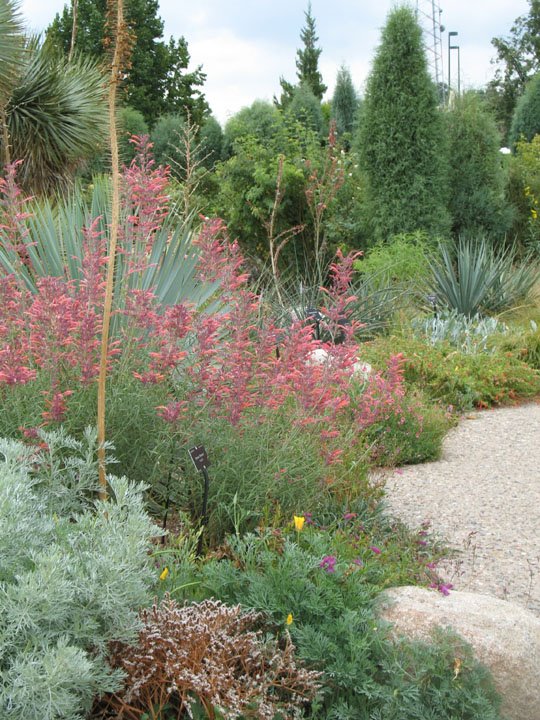 Another garden that I found particular thrilling was the water smart garden. Here many of the perennials and shrubs are displayed that show homeowners beautiful plants that survive with a minimum of water and care...and they thrive! Just look at the rich textures! The mix of greens, silvers and blues is spectacular, puncuated by the prolific blooming of hyssop plants! Seen in this image are Sages, Creeping Verbeena, Hyssop, California Poppies, Penstemon, and the wonderfal varieties of Yuccas and Century Plants! I now have a new fondness for Yuccas and Century Plants!
So now that I know it can be done, now we have to challenge ourselves to figure out how to do it on a bigger scale, and do it cost effectively! A big challenge indeed, but I feel up to it! We have too, water supplies are finite, and with the ever increasing population, the green turf grass we see everywhere, will soon be a dinosaur.
Saturday, September 09, 2006
Habitat Update Week of 9-05-06

Wow, Habitat got a lot done last weekend! The majority of the first floor walls are now up, and getting ready for the second floor deck. Things are moving along fast now!
Subscribe to:
Posts (Atom)


 Posts


